Connecticut Dog Registration Information
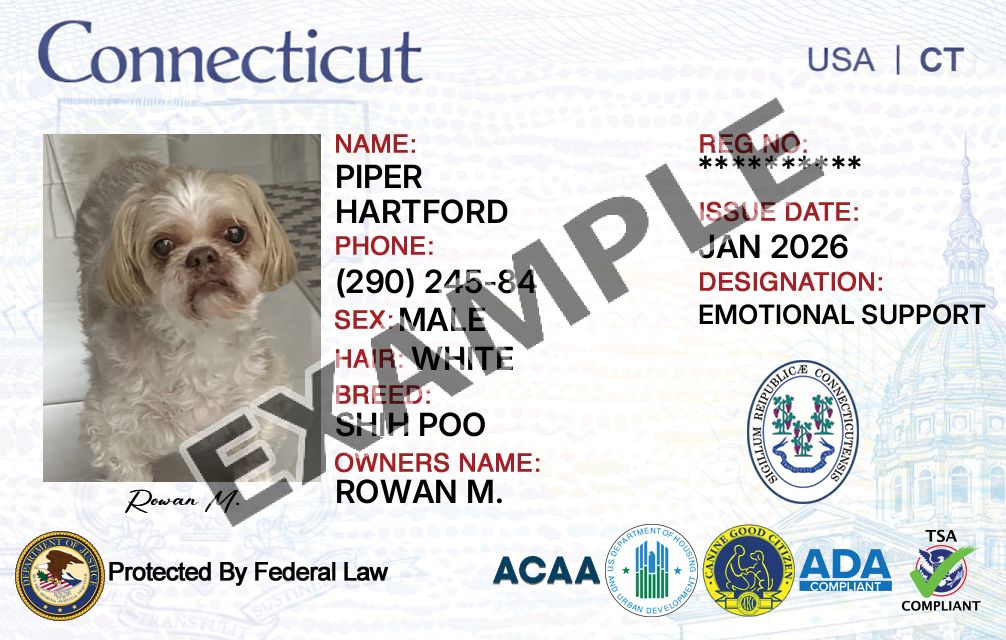
State Licensed, Service Dogs and Emotional Support Dogs in Connecticut
If you’re asking, “where do I register my dog in Connecticut for my service dog or emotional support dog?” the answer is usually simpler than it sounds: in Connecticut, registering your dog typically means getting a dog license in Connecticut through your local town or city clerk (and sometimes through a local animal control partner).
This page explains where to register a dog in Connecticut, how local licensing works, what rabies paperwork is commonly required, and how licensing differs from a dog’s status as a service animal or emotional support animal.
Where to Register or License Your Dog in Connecticut
Because licensing is handled locally, you typically register (license) your dog with the town/city clerk in the municipality where your dog is kept. Below are example official offices in Connecticut. If your town is not listed, look for your local “Town Clerk,” “City Clerk,” or “Dog License” page through your municipality.
City of Hartford — Town & City Clerk (Dog Registration)
- Address: 550 Main St., 2nd Floor, Room 104, Hartford, CT 06103
- Phone: (860) 757-9311 (Hartford 311)
- Email: LUSAE001@hartford.gov
- Office hours: Mon–Thu 8:15 AM–4:30 PM; Fri 8:15 AM–3:00 PM
City of New Haven — City Clerk (Processes Dog Licenses)
- Address: 200 Orange Street, Room 202, New Haven, CT 06510
- Phone: (203) 946-8339
- Email: (Official page lists an email contact for the City/Town Clerk; use the City Clerk’s email contact on that page.)
- Office hours: Mon–Fri 9:00 AM–5:00 PM
City of Bridgeport — Town Clerk
- Address: 45 Lyon Terrace, Bridgeport, CT 06604
- Phone: (203) 576-7208
- Email: Christina.Resto@bridgeportct.gov
- Office hours: Mon–Thu 9:00 AM–4:00 PM; Fri 9:00 AM–4:00 PM (recordings 9:00 AM–12:00 PM)
City of Norwalk — Town Clerk
- Address: 125 East Ave., Room 102, Norwalk, CT 06851-5125
- Phone: (203) 854-7747
- Email: (Town Clerk staff page lists email contacts; use the official Town Clerk email contact shown there.)
- Office hours: Mon–Fri 8:30 AM–4:00 PM
State-level resource (not a license issuer): Connecticut Department of Agriculture — Animal Control Unit
If you need help understanding animal control dog license Connecticut enforcement, nuisance dog issues, dog-related complaints, or state-level guidance (including rabies control), the state’s Animal Control Unit is a primary agency involved in enforcement and oversight. This office generally does not replace your local town/city clerk for routine licensing, but it is a key statewide authority for dog control and rabies control enforcement.
- Office name: Connecticut Department of Agriculture — Animal Control Unit
- Address: 450 Columbus Boulevard, Suite 702, Hartford, CT 06103
- Phone: (860) 713-2506
- Email: agr.animalcontrol@ct.gov
- Office hours: Not listed on the referenced unit page
Overview of Dog Licensing in Connecticut
What “registering” usually means in Connecticut
In everyday terms, when people ask where to register a dog in Connecticut, they usually mean a municipal dog license. Connecticut law requires owners/keepers to license dogs that are six months or older in the town clerk’s office in the town where the dog is kept, generally by June 30 each year. This is the baseline rule for most households, including those with a service dog or emotional support dog. (Connecticut General Statutes § 22-338.)
Why dog licensing exists (and what the tag does)
Local licensing supports animal control services, public health and rabies prevention efforts, and helps return lost dogs to their owners. After licensing, your dog typically receives a numbered tag that should be attached to the dog’s collar when required by local rules. Many Connecticut municipalities emphasize that licensing and tags help identify ownership quickly if a dog is found, and that late renewals may trigger monthly penalties. (Examples: municipal licensing pages; CT statute § 22-338.)
Rabies vaccination documentation is a core requirement
Connecticut’s licensing laws are tied closely to rabies control. A rabies vaccination certificate is recognized as the official proof of vaccination for licensing purposes and is submitted to the town clerk when you license your dog. State law also specifies what information the rabies vaccination certificate must contain (owner details, animal description, vaccination date, duration of immunity, vaccine details, and veterinarian signature/license). (Connecticut General Statutes § 22-339c; see also § 22-339a regarding submission of proof to the town clerk for licensing situations.)
How Dog Licensing Works Locally in Connecticut
Step-by-step: how to get a dog license in Connecticut
- Find the correct licensing office for your town/city. In Connecticut, licensing is generally done through your Town Clerk or City Clerk. Some municipalities may also deputize an animal pound/shelter as an agent for issuing licenses, but the clerk remains responsible for compliance. (CT statute § 22-339a; municipal examples.)
- Gather required documents. Most offices ask for (a) proof of current rabies vaccination and (b) proof of spay/neuter status (when applicable), plus payment and sometimes a self-addressed stamped envelope if applying by mail. (Municipal licensing instructions commonly list these items; CT statute framework § 22-338 and rabies certificate requirements § 22-339c.)
- Apply in the way your municipality offers. Many Connecticut towns accept licensing in person, by mail, and sometimes online renewal. Some places may require first-time licensing to be done in person. Always follow your municipality’s instructions because local workflows vary even though the state rule is consistent. (Municipal examples.)
- Receive your license and tag. Once processed, you’ll typically receive a license record and a tag. Keep a copy of your paperwork for housing requests, veterinary records, travel, and proof for local compliance.
What if you moved within Connecticut?
Because licensing is local, if you move to a different Connecticut municipality, you should contact the new town/city clerk to ask when they require you to license in the new town and what proof they need. The general statewide standard is based on where the dog is “kept” and local enforcement is handled locally and through animal control. (CT statute § 22-338; CT Department of Agriculture Animal Control Unit description.)
Who enforces licensing and rabies rules?
Enforcement can involve local animal control and local public health processes, with statewide oversight and enforcement roles described by the Connecticut Department of Agriculture’s Animal Control Unit (including enforcement of laws pertaining to licensing and control of dogs and rabies control). If you have a complex situation—such as a dispute over nuisance behavior, bites, or rabies control steps—your local animal control and the state Animal Control Unit may be relevant contacts. (CT DOAG Animal Control Unit.)
Service Dog Laws in Connecticut
Service dog legal status is not the same as a license
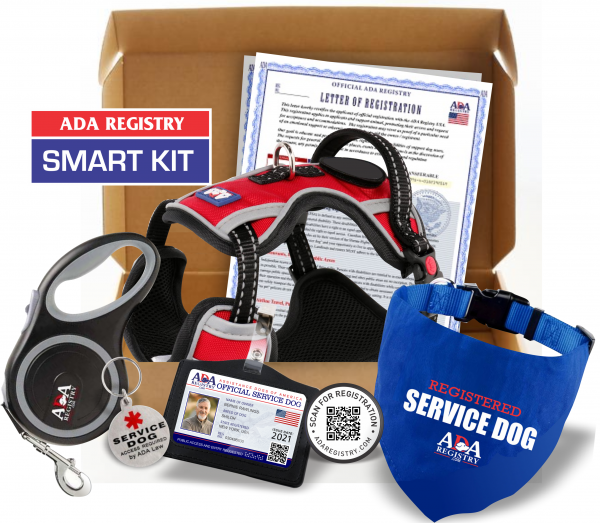
A dog license in Connecticut is a local registration requirement for dogs living in a town. A dog’s legal status as a service animal, however, is primarily defined at the federal level for public access under the Americans with Disabilities Act (ADA). Under ADA guidance, a service animal is generally a dog that is individually trained to do work or perform tasks for a person with a disability. Importantly, the ADA does not require a service dog to be professionally trained, certified, registered, or to wear a vest/ID. (ADA service animal guidance.)
Public access: what businesses may ask
If it’s not obvious that a dog is a service dog, ADA guidance explains that staff may generally ask only two questions: (1) whether the dog is required because of a disability, and (2) what work or task the dog has been trained to perform. Staff are not supposed to demand documentation that the dog is “registered” or “certified” as a service animal. (ADA service animal guidance and FAQs.)
Do service dogs still need local licensing?
In most cases, yes—you should still follow local licensing rules for any dog kept in your municipality, including service dogs. Some towns may have specific fee rules (for example, certain municipal pages note service dogs may be free to license), but you must confirm with your local clerk because policies and implementation can vary. State law sets baseline licensing requirements and municipal offices administer the process. (CT statute § 22-338; municipal examples.)
Emotional Support Animal Rules in Connecticut
Emotional support dogs are not service dogs under the ADA
Many people search for “service dog or emotional support dog registration” as if both are handled the same way. They are not. ADA guidance distinguishes service animals from emotional support animals: an animal whose only function is to provide comfort or emotional support (without trained tasks) is not a service animal under the ADA. That means an emotional support dog generally does not have the same public-access rights (restaurants, stores, etc.) as a task-trained ADA service dog. (ADA service animal guidance.)
Housing is where ESAs most often apply (Fair Housing Act)
Emotional support animals are commonly addressed under federal housing rules. HUD explains that an assistance animal in housing can be an animal that performs tasks or provides emotional support that alleviates one or more identified effects of a person’s disability—and that assistance animals are not pets. Under the Fair Housing Act framework described by HUD, a person may request a reasonable accommodation to a housing provider’s pet restrictions for a disability-related need. (HUD assistance animal guidance.)
Licensing still applies locally
Even if your dog is an emotional support dog for housing purposes, your town may still require a local dog license and proof of rabies vaccination, because those are public health and local compliance requirements separate from housing accommodations. If you’re trying to figure out where do I register my dog in Connecticut for my service dog or emotional support dog, the licensing destination is typically the same: your local clerk’s office. (CT statute § 22-338; rabies certificate requirements § 22-339c; HUD assistance animal guidance.)
Frequently Asked Questions
Disclaimer
Licensing requirements and office locations may change. Residents should verify details with their local animal services office within Connecticut.
Register A Dog In Other Connecticut Counties
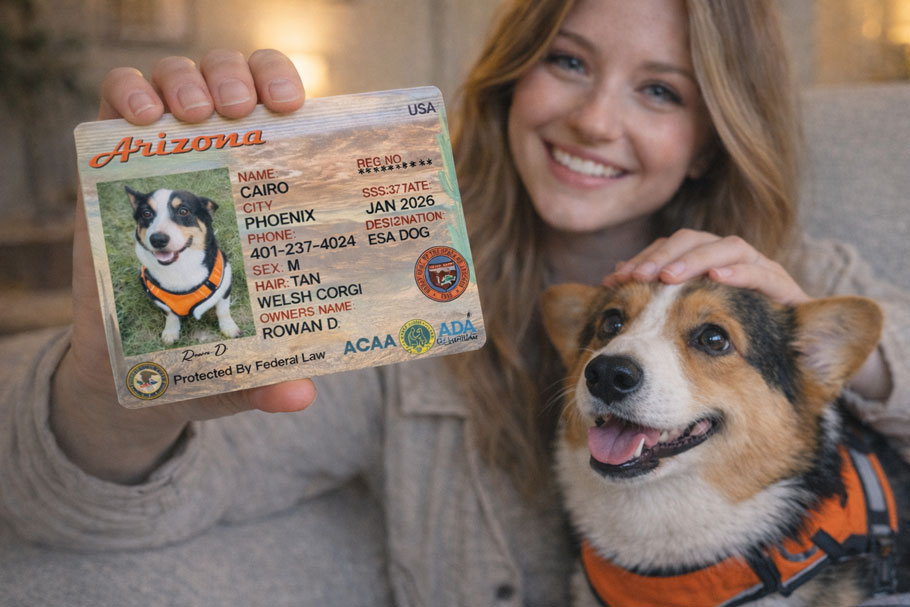
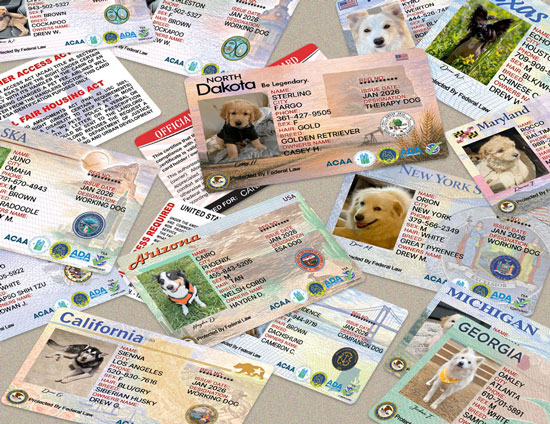
Select your county from the dropdown below to get started with your dog’s ID card. Requirements and license designs may vary by county, so choose your location to see the correct options and complete your pup’s registration.
- Capitol County Dog Registration
- Connecticut's eight historical counties County Dog Registration
- Fairfield County Dog Registration
- Greater Bridgeport County Dog Registration
- Hartford County Dog Registration
- Litchfield County Dog Registration
- Lower Connecticut River Valley County Dog Registration
- Middlesex County Dog Registration
- Naugatuck Valley County Dog Registration
- New Haven County Dog Registration
- New London County Dog Registration
- Northeastern Connecticut County Dog Registration
- Northwest Hills County Dog Registration
- South Central Connecticut County Dog Registration
- Southeastern Connecticut County Dog Registration
- Tolland County Dog Registration
- Western Connecticut County Dog Registration
- Windham County Dog Registration